

What might happen when you take your dog to sheep for the first time?
When taking your dog to sheep for the first time, be prepared for almost any reaction! Some young dogs aren’t interested, some merely curious. If you’re lucky your dog will calmly cast out and around the sheep – that’s not as common as the dog that rushes in and scatters them.
Remember, the dog may have a very short attention span – sometimes just a few seconds but more usually a few minutes. The younger the dog, the shorter the attention span will probably be.
If the dog runs around the sheep for a little while and then walks or runs away to do something else (often eating sheep droppings) it’s a fairly reliable sign that he’s tired or bored. Try to get his attention back on the sheep but don’t persist. Better to stop the session for a while – maybe an hour or until the next day.
What to teach first
It’s probably safest for novice handlers to teach the dog to lie down before they take it to the sheep. This does not mean that the dog will lie down at this time – it’s highly unlikely that it will – but at least it’ll understand what the command means. Later, when you’re blocking the dog’s path, holding up your arms and repeating the command, the dog will eventually obey you. It should respond more quickly to ‘lie down’ if it knows what you mean. Some trainers argue that teaching a dog to lie down before you take it to the sheep can teach it to focus its attention on you rather than the sheep. That might happen temporarily but as the dog’s confidence grows, it’ll focus more on the stock. If it doesn’t, there’s a deeper rooted confidence problem that needs to be addressed.
Our Basics tutorial category is a good place to prepare yourself before you begin.
What you can expect
If you take a novice dog to sheep and simply let him go, he’ll respond to them in one of several ways:
1. Run straight at the sheep and attack them or split them up.
Despite appearances, this is a really good reaction. It means the dog’s working instinct is strong, and provided we get control of the dog and train it, it’s going to be a really good sheep or cattle dog.
2. Chase the sheep into a corner then lie down and stare at them.
Once again, this is a good sign. Even though the dog’s not actually moving the sheep, the working instinct is strong. A lack of confidence is causing the dog to lie down and stare at the sheep. It lacks the confidence to take any action and doesn’t know what to do. By keeping the dog and the sheep moving, we can easily build the dog’s confidence, and “sticky” dogs are often easy to train once we get them moving.
3. Ignore them or even run away.
This is not so good. The dog either has a big confidence problem, or its working instinct is dormant. We have two training tutorial videos which can help you to train a dog like this.
4. Run out around the sheep and bring them to you!
Sadly this is not the most likely reaction but it does happen from time to time! When it does, you’re very lucky indeed. There’s every chance that your dog will be really easy to train on stock.
Protect the stock from an aggressive dog
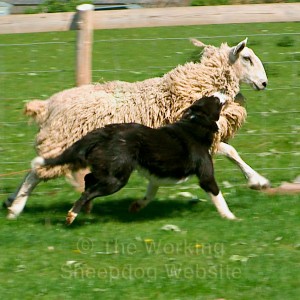
If the dog attacks the sheep, of course we must get the situation under control as quickly as possible, to protect the sheep. We do this by bringing the sheep into a circular pen of approximately 16 metres (17.5 yards) diameter. Training the dog inside this pen enables the handler to control the dog much more easily by blocking it (getting between the dog and the sheep, and keeping the dog away from them). The best way to block the dog and keep it away from the sheep is by using a lightweight training stick. The stick is NOT used for striking the dog. Instead, it’s used in such a way that the dog sees it as a deterrent against getting too close to the sheep. We have a video tutorial on correct use of the training stick.
Why is the dog aggressive?
Much of the dog’s initial aggression and excitement around stock is the result of a lack of confidence. Master the technique of blocking the dog to make it stay back from the sheep. Once it begins to calm down the proper training can begin.
After a little while, the dog will react according to the way the sheep and handler move. By positioning yourself carefully, you can have a great influence on the dog’s next movement. If you can anticipate which way your dog and the sheep will move and give the appropriate command at the right time, you’ll encourage the dog to move in a certain way when you tell it to. What you should be doing is using the position of your body together with commands to help the dog control the sheep.
Try moving the sheep without a dog
As a novice, you’ll be surprised how your dog moves and even more surprised at the way in which the sheep move. An ideal way to learn how sheep will react to where you put your dog is to drive them yourself. This is only really practical in a fairly confined space. If you’re able to practice driving sheep around (alone) you’ll gain a wealth of valuable experience to help with dog training and especially handling.
A yard or very small paddock is ideal for the task. Once you have the sheep in it, you simply decide where you want the sheep to go and drive them there. Not as easy as it sounds I can assure you!
If you don’t have anywhere suitable to practice this, you may be able to help a local farmer when he’s moving his sheep. If not, study every sheepdog video you can, taking careful note of the reaction of the sheep to the dog and handler.
WE CAN HELP YOU TRAIN YOUR DOG TO WORK SHEEP, CATTLE OR OTHER LIVESTOCK
If you’re interested in training a dog to work sheep, cattle, or other livestock, we can help you – whether you’re a complete beginner, or just wanting to improve.
For French, Spanish or English SUBTITLES click “CC” on player.

For a very small monthly (or annual) subscription, watch many hours of expertly presented sheepdog training lessons. Not just theory – we show you what should happen, and what to do when things go wrong. Signup now. It’s easy to cancel payments at any time and you can continue to watch for the period you paid for.
Find out how members can send videos for our assessment and advice on their dog’s progress.


Leave a Reply